
Joël Brisse (1953)
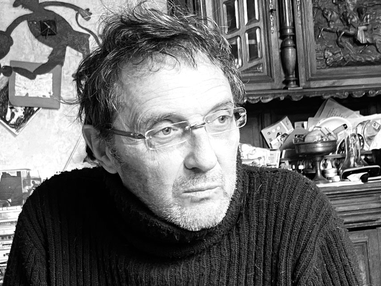
Contemporary painter exhibiting at Galerie Catherine Pennec in Clermont-Ferrand, Auvergne (France) in 2026
Biography of Joël Brisse
Born in Vichy in 1953, Joël Brisse has been painting and exhibiting his works for many years. Since 1997, he has also been making films and working on screenplay writing. Joël studied fine arts in Clermont-Ferrand and later settled in Paris.
His first Parisian exhibition took place at Galerie Diagonale with Egidio Alvaro. He was part of Zig Zag dans la Savane, a transdisciplinary group of artists—performers, visual artists, dancers—who staged interventions in abandoned spaces. In 1985, Bernard Lamarche-Vadel presented his paintings at Galerie Claudine Bréguet. From the late 1980s through the 1990s, his main exhibitions were held at Galerie Philippe Gravier in Paris. In the following years, his work was shown at Galerie Nathalie Gaillard and Galerie Duboys.
In 2009, the Roger-Quilliot Art Museum in Clermont-Ferrand dedicated the exhibition L'Habit Rouge to him. One of his works is also part of the FRAC Auvergne collection.
"I create images by working against them, against their literalness. I need to feel that there is something unresolved, something unspeakable—a density and meaning that come from painting itself rather than its subject. The subject is a vehicle through which I enter ‘the swamp where all reference is blurred.’ At a certain point in the process, something has to set (like plaster), and the image truly becomes autonomous, like a small world with its own rules. There is a paradox in painting: it creates intimacy with the viewer while at the same time holding them at a distance."
Recent Exhibitions
2026 | CLERMONT-FERRAND | "Le Jardin des Oliviers" | Galerie Catherine Pennec
2025 | PARIS | "L'Oeil du Lièvre" | Galerie Jorge Alyskewcz
2025 | CARSAC-AILLAC | Galerie La ligne bleue
2025 | LA-PIN-LA-GARENNE | Galerie Nathalie Gaillard
2024/2025 | VITRY-SUR-SEINE | "Faits Divers" | Mac Val
2023/2024 | VITRY-SUR-SEINE | 'L'oeil vérité" | Mac Val
2022 | SALLE-LA-SOURCE | Galerie La Cascade
2022 | L'ISLE-SUR-LA-SORGUE | Centre d'art de Campredon
2021-2022 | L'ISLE-SUR-LA-SORGUE | "Visage/Paysage" | Centre d'art de Campredon
2021 | PARIS | Galerie Nathalie Gaillard, C2Art
2019 | ISSY LES MOULINEAUX | Biennale d'Issy-Les-Moulineaux
2017 | LILLE | "Passion(s)" | Centre d'Art Sacré
2016 | PARIS | Galerie Duboys
2012 | FONTENAY-SOUS-BOIS | "Dormeurs-Dormeuses" | Halle Roublot
2009 | CLERMONT-FERRAND | Musée Roger Quillot
Public Collections
- Roger-Quilliot Art Museum, Clermont-Ferrand
- Bernard d'Agesci Museum, Niort
- Museum of Contemporary Art of Val-de-Marne
- Fonds National d’Art Contemporain
- FRAC Île-de-France
- FRAC Auvergne, Clermont-Ferrand, France
- Leepa-Rattner Museum of Art, Tarpon Springs, Florida
- City of Paris
- City of Clermont-Ferrand
- City of Issy-les-Moulineaux
- Fondation Coprim, Paris
- Fondation Ricard, Paris
- Fondation Colas, Paris
- Quasar – Donation Lesgourgues, Saint-André-de-Cubezac
- Publications
- L’Habit Rouge, 2009, Musée Roger Quilliot
- Suite Parlée, 23 monologues, Filigranes Editions, 2010
- Joël Brisse, Galerie IUFM Confluence(s), 2009
- Ligeia, January & June 2006
- 99 textes (La pellicule ensorcelée website), 2005/2006
- Rehauts (chutes), May 2005
- In-quarto, studio writings with Vincent Barré, Joël Brisse, Bernard Cousinier, Léo Delarue
- Texts for Alain Platel, Laurent Achard, Dominique Boccarossa, Alain Raoust, Florent Marci, Vincent Barré, Micha Roginsky, Léo Delarue, Caroline Fontaine, and others
Filmmaker and Screenwriter
- J’ai tué ma femme, co-directed with Marie Vermillard, 2017, 30 min
- Les Oliviers, 2013, 30 min
- Suite Parlée, co-directed with Marie Vermillard, 2009, 77 min
- La Fin du règne animal, co-directed with Marie Vermillard, 2003, 107 min
- La Gardienne du B., 2002, 40 min
- Jouir, Tuer, Rêver, Bouger, Mentir, 2001, 5 × 5 min
- La pomme, la figue et l’amande, 2001, 35 min
- Le Songe de Constantin, 1999, 22 min
- Les Pinces à linge, 1998, 22 min
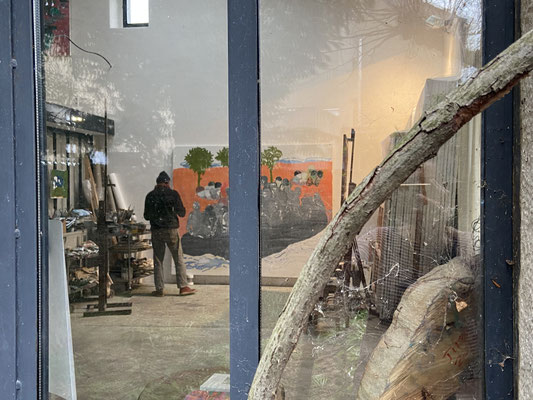
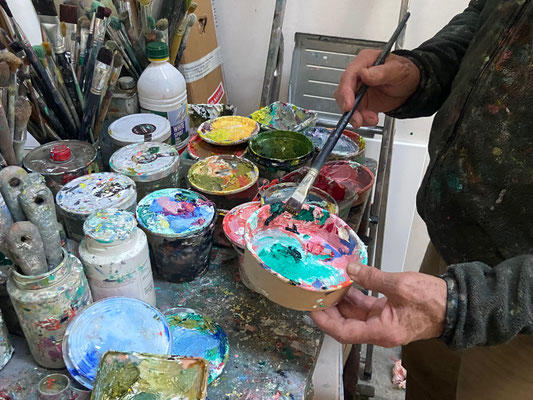
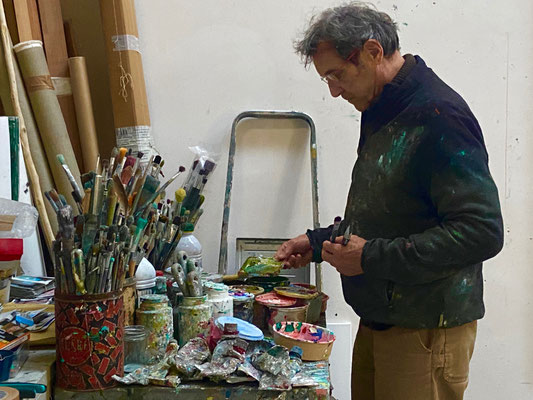
Joël Brisse in his studio
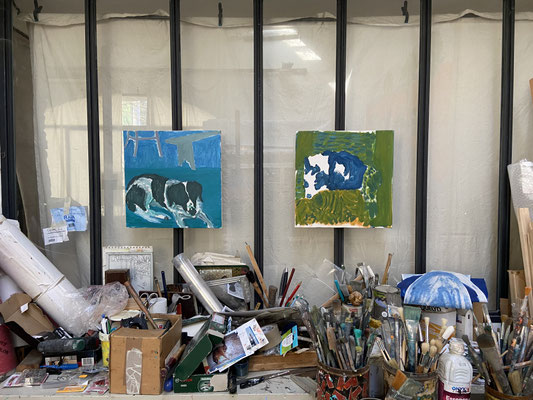
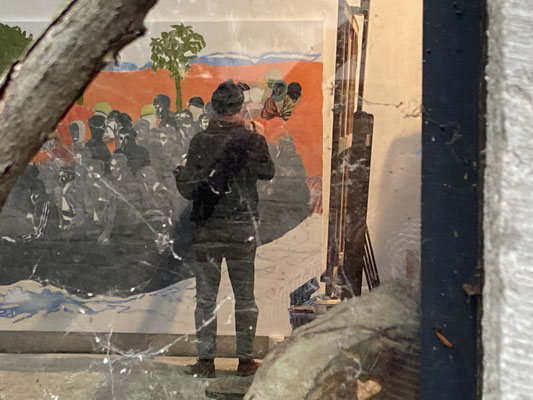
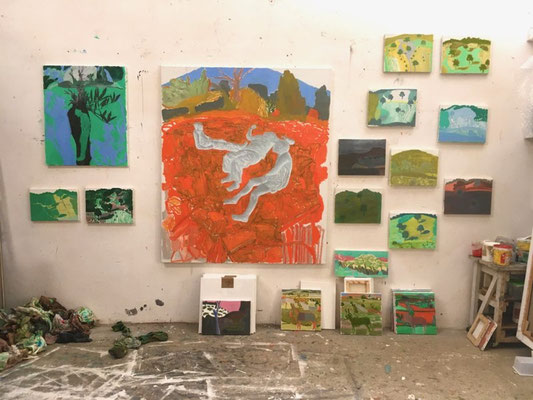
Joël Brisse pieces of artwork - oil on canva
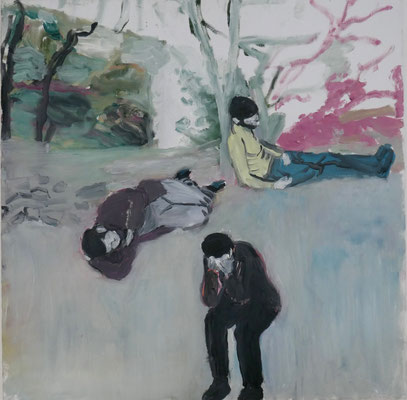
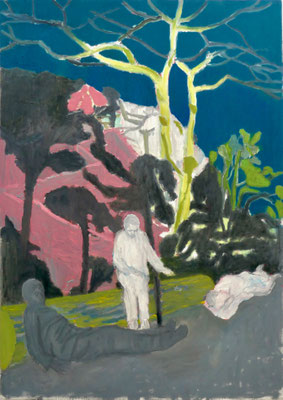
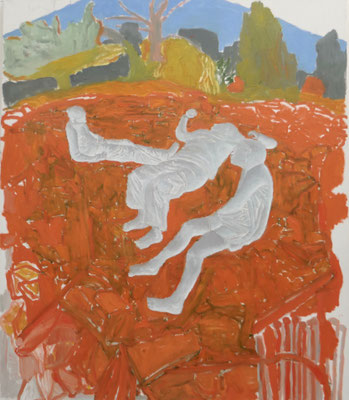
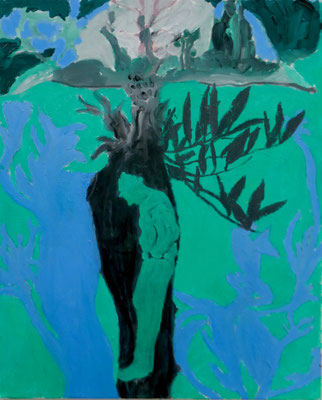
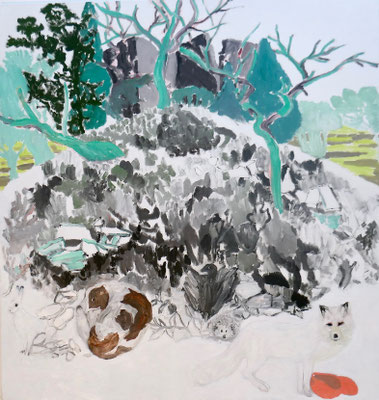
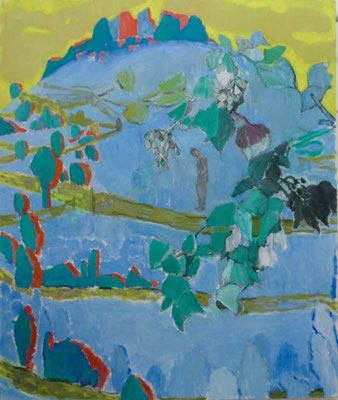
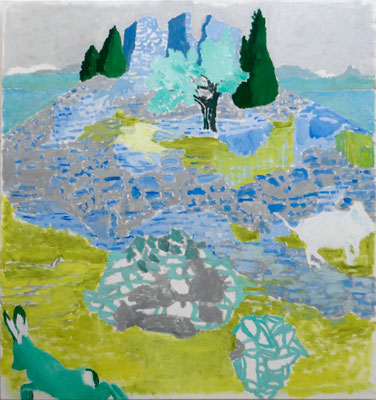
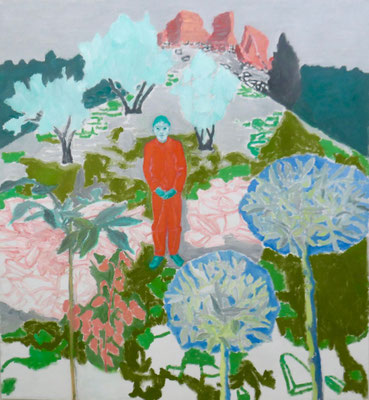
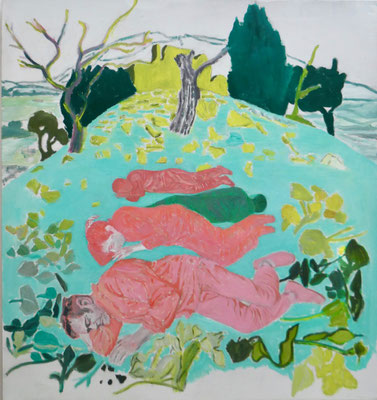
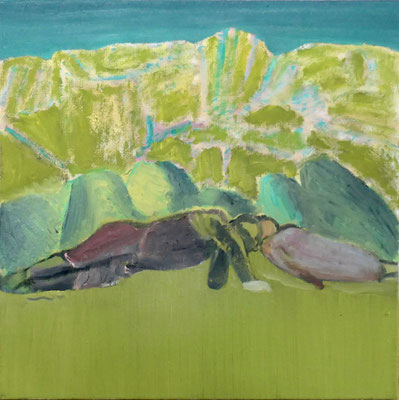
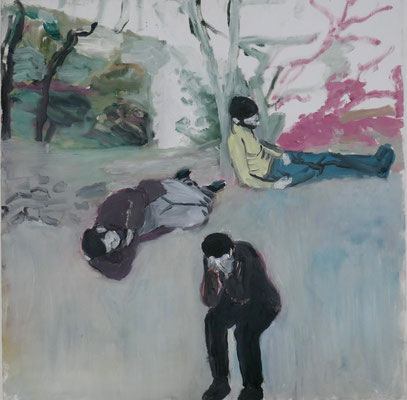
Artworks by Joël Brisse, from the exhibition “Le Jardin des Oliviers,” available at the gallery

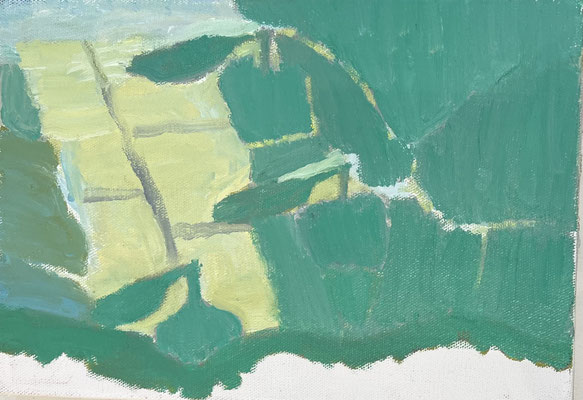
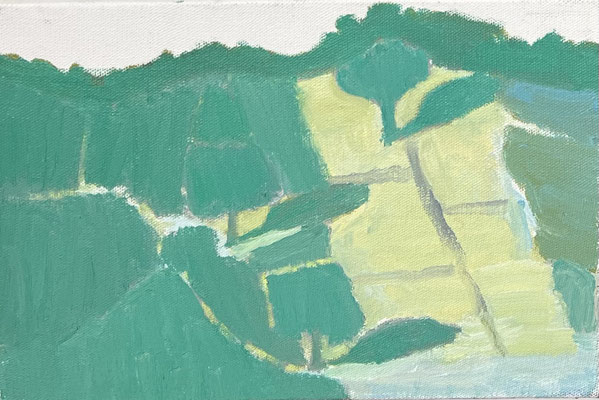
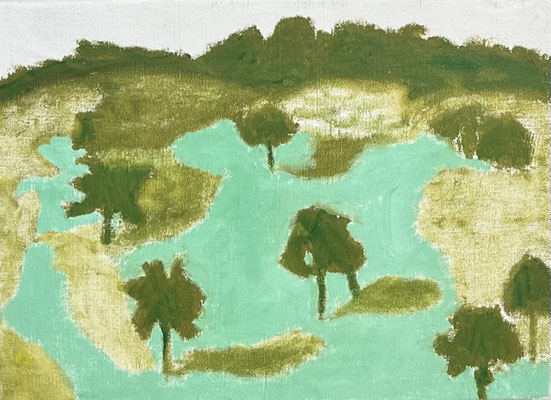

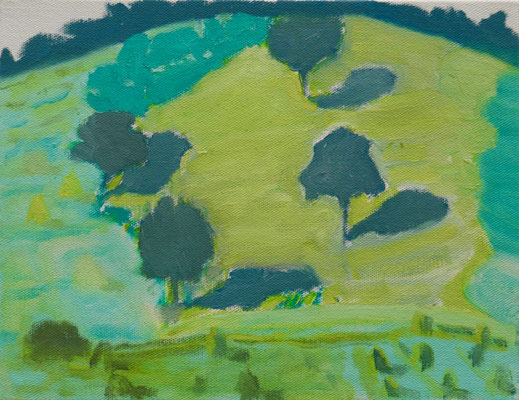
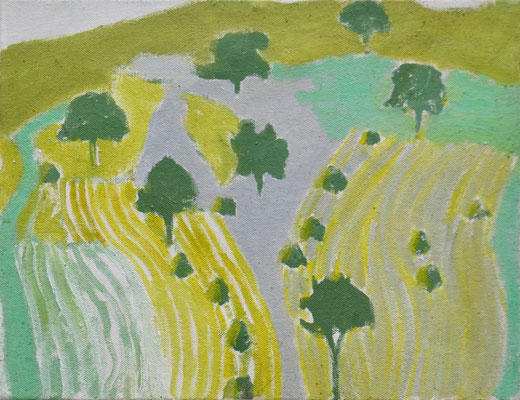
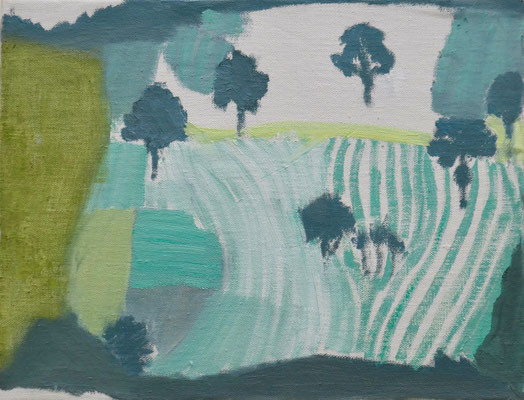
Interview between Justine Malaty, student in 2nd degree of History of Art of the University if Clermont Auvergne (UCA) and the artist Joël Brisse on June 19, 2026
Justine: In the interview you gave with Catherine Pennec for the exhibition The Garden of Olives, you said "to embrace a reference while at the same time trying to blur it." How do you concretely achieve this blurring in your works?
Joël: In the case of “The Garden of Olives”, the pictorial and biblical reference is obvious. What interests me is the pictorial device, the staging if you like. Three figures are asleep on the side of a hill, while a fourth keeps watch at the top. Even without knowing the biblical story, the scene tells us something. It speaks of a distance between the figures: the distance between the watchman (the conscious) and the sleepers (the unconscious), between the anxious one and the innocent ones.
If you remove Christ, you remove that distance, you disrupt the reference. The sleepers are no longer connected to the one who bridges the void or rather, who fills the metaphysical void. They are left alone in their sleeping solitude, vulnerable to the viewer's gaze. And that, to me, is emblematic of painting as something made to be looked at. Every sleeper is vulnerable to the gaze. There are countless sleepers throughout the history of painting, countless languid, reclining figures. Sleep, after all, is a kind of little death, in the sense that we absent ourselves from the world.
But that only partly answers your question. There are always two stages to my process.
I always begin with photographs I have taken myself. The initial subject finds its place: always at the centre of the painting. The subject occupies the centre because it is both the cause and the pretext for the painting, much as in family photographs our attention naturally focuses on the person placed at the centre. I am well aware that there is something almost anti-painterly about introducing the human figure into the picture. In any case, I have to begin with something drawn from the real world in order to arrive at painting.
That is where the second stage begins. I try to move beyond the image, to distance it from its anecdotal quality, to alter its temporality. The work of painting extracts it from its original context and renders it timeless. It is, in a sense, a temporal shift: the image acquires something abstract and mental.
I have always loved early Sienese painting, as well as the frontality and flatness of Piero della Francesca's works: their dramatic flatness, the ordinariness of their drama. I do not disembody the figure, I place it at a distance. That distance privileges the act of looking, the exchange of gazes between the viewer and the painted subject. And that transformation is brought about by the way I paint.
Justine: In your engagement with the Italian Primitives, does the reference matter to you in and of itself, or is it more of an assimilated source, something that nourishes your work without necessarily being explicitly perceptible?
Joël: The reference itself is not important to me as a historical one. What draws me to that period is the images it has left me with: their simplicity, their ingenuousness, their metaphorical dimension. Seen from a distance, they evoke a kind of childhood of space and of destiny. And when I say that, it is not the result of academic study. It simply comes from spending time with the works themselves, or with reproductions of them, and from the feeling they evoke in me. It corresponds to a state of mind that I enjoy experiencing whenever I look at painting.
Romanesque art moves me in much the same way: its closeness to the earth and the elements, its rudimentary quality, which places us, almost naively, in intimate contact with mystery. The painted figures are ordinary people. Gothic art distances us from that, except perhaps in the stained-glass windows, those of Clermont Cathedral, for example, the work of craftsmen. While the windows themselves are luminous vertical bands rising towards the heavens, the stained glass is nevertheless divided into medallions depicting scenes that are firmly rooted in earthly, even rural, life.
I suppose what I have internalised is a sensation: the formal and spiritual integrity of those works, a quality that I continue to seek in painting, including my own.
Justine: The Italian Primitives created their work within an explicitly religious context. How do you translate that spiritual dimension into a contemporary visual language, without an explicit religious framework?
Joël: It is not the subject that gives painting its spiritual dimension. Rather, it is a way of inhabiting the image. At that time, paintings were almost exclusively religious, there were not yet portraits or landscapes. (I believe the first true portraits are those of Federico da Montefeltro and his wife by Piero della Francesca.)
As for me, I either ask someone to pose, or I work from photographs I have taken myself, of people or landscapes. Occasionally, when I have a more explicitly political intention, I use images found online, such as photographs of wild animals or boat people. But that does not alter the way I paint.
The use of colour that is not necessarily naturalistic, the suspended quality of the figures, a drawing that appears awkward, a deliberate awkwardness that gives the work a rudimentary character, and a certain ingenuousness (a term I used earlier in relation to Romanesque art): all of these are ways of connecting us to something that is at once enduring and shared by everyone.
Justine: Your pictorial space is not constructed through perspective in the way it is in Italian Primitive painting, yet it still appears carefully composed. How do you conceive of that pictorial space?
Joël: The Italian Primitives were not yet governed by the "ideology" of perspective and the need to organise everything around a single vanishing point. The vanishing point captures both space and the viewer's gaze. Reality is deferred into that point, which draws everything towards itself and suggests the existence of an invisible, fictional elsewhere.
What I admire in Bernardo Daddi or the Lorenzetti brothers is that everything is there, visible, accessible, almost didactic in the popular sense, the lesson does not descend from above, as it does in Gothic art. They also practised reverse perspective: buildings widen as they recede from the viewer, and all their sides remain visible because God sees everything. That is the Byzantine legacy. It is the very opposite of linear perspective.
Contrary to what we are taught at school, the invention of perspective was not simply a technical advance, it reflected a profound shift in ways of thinking. Romanesque art presents a form of religion that feels more open and freer, before the Church imposed its hierarchy and a certain form of totalitarianism.
Today there are no longer any avant-gardes or artistic movements. Contemporary art recycles everything, including classical painting.
I have no interest in creating the illusion of three-dimensional space or reproducing depth through the devices of perspective. What interests me is the surface of the painting as a wall that I cannot enter. Everything exists on the same plane, flattened onto the picture surface, much as it does in fresco painting. It is the viewer who reconstructs the space.
Forms, figures and signs are placed upon the surface like motifs against a ground. What I seek are the transitions and tensions between them.
Justine: You have said that "the subject does not move across a background, it belongs within it." How does this unity between figure and ground take shape in your painting process?
Joël: I work a bit like playing dominoes. I place one piece, then another, and so on. Sometimes everything falls into place immediately. Sometimes I leave an empty space where the figure will eventually appear. Sometimes it simply does not work, the figure refuses to settle into the painting. It disappears, only to return in a different form. At other times, the opposite happens: it is already there, floating on the white ground, and the painting gradually closes around it.
There is always a moment when I simplify, when I remove details. It is not a matter of elegance, but of necessity, of what feels self-evident. Certain rough or seemingly crude marks can contribute to that sense of inevitability.
The idea of a "well-chosen colour" does not really mean anything to me. I am not looking for visual comfort. On the contrary, I try to disturb any harmony that comes too easily. There has to be a kind of accepted visual discomfort, one that gives rise to an unexpected harmony.
The forces at work within the painting may be contradictory, yet they all move in the same direction. That is where the feeling of strangeness comes from, it arises more from the form than from the subject itself. There is an invisible drama, carried by the sensuality of the paint.
Justine: The Italian Primitives often created a sense of depth that was mental or symbolic rather than illusionistic. Do you see a similar kind of spatial depth in your own work?
Joël: Yes. Each painting is like a tale. In that sense, each one is unique: a self-contained world, complete in itself and independent. It contains a metaphor that I would be unable to explain. I can see that I am trying to tell something, but I do not know exactly what.
Each painting holds a question about presence, about the gaze, perhaps about an awareness of disappearance, about the wonder of existing, or simply of being here.
The figures float, and, paradoxically, so does the marshland surrounding them. They look at the viewer as though silently addressing a friend, yet without breaking each one's solitude. Familiarity and distance coexist, our companionship is an illusion.
I need to feel that mental bond with the painting, a connection that is quietly unsettling.
Justine: You have spoken about a period when you were trying to simplify the figure. What motivated that search?
Joël: In fact, this relates to your previous question about mental depth. That period made me realise that painting is not limited to its image. By "image" I mean what is represented in the painting, even if it is abstract. Painting can serve another purpose. It can become a kind of synthesis of sensations, something we might call interiority, a metaphysical dimension, or simply presence.
I do not know whether that comes from within the painting itself, or whether the painting echoes an external pulse, the painter's own. Or perhaps, in some indefinable way, it evokes the human condition.
I found that Malevich's figurative paintings possess a metaphorical dimension. His Running Man is the very essence of flight, of passing time, of the human condition. And that is inseparable from formal simplification, which strengthens metaphor, rather like fables, with their simple stories, simple gestures, the basic acts of survival: day, night, I look, I move, I sleep, I eat, I eat you...
That is what I was trying to find. I stripped away every element of setting. The figure stood against a monochrome ground, suspended in nothing but the painted surface itself. It was a radical approach. When you are young, you need to be radical, to assert a position. Later, I continued along that path, but with greater formal freedom.
Justine: Andrea Mantegna is an explicit point of reference in your work. Which other artists have had a lasting influence on your practice?
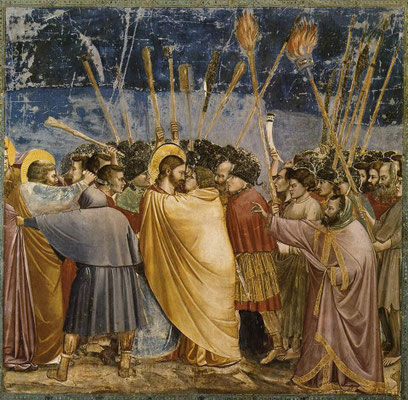
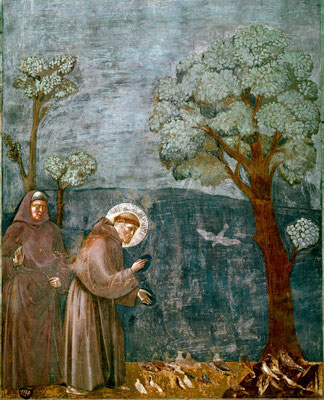
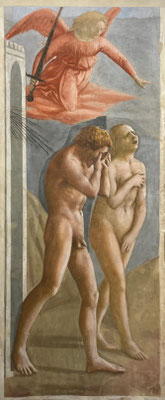
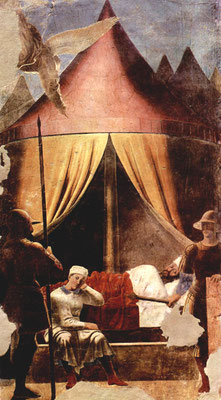
Joël: Almost all of them, to varying degrees. There are painters, of course, but also individual paintings. Here are just a few examples that have remained etched in my memory:
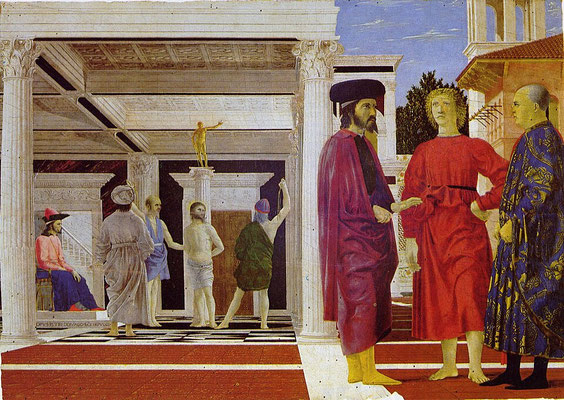
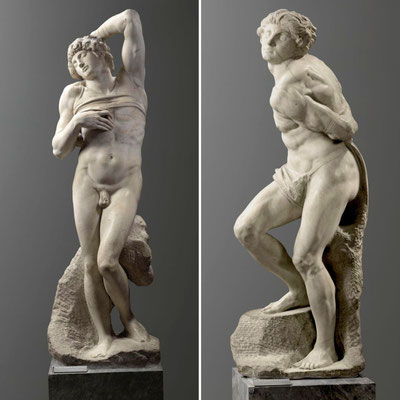
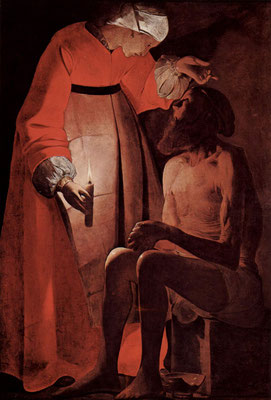
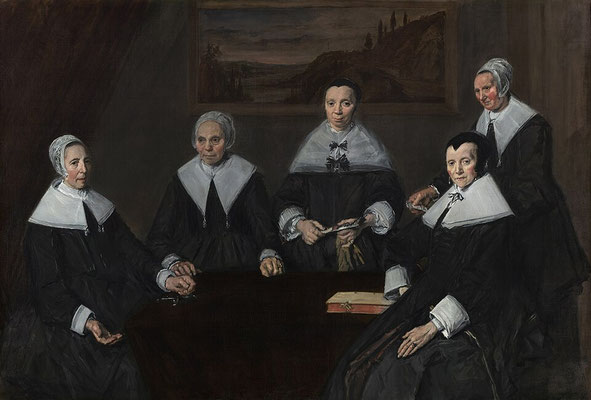
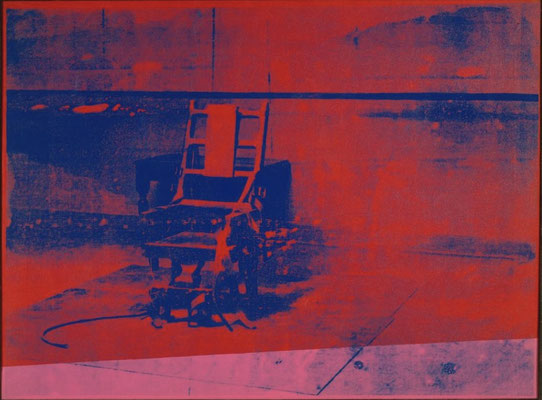
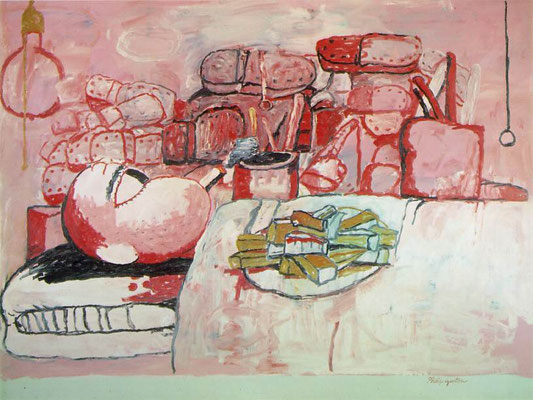
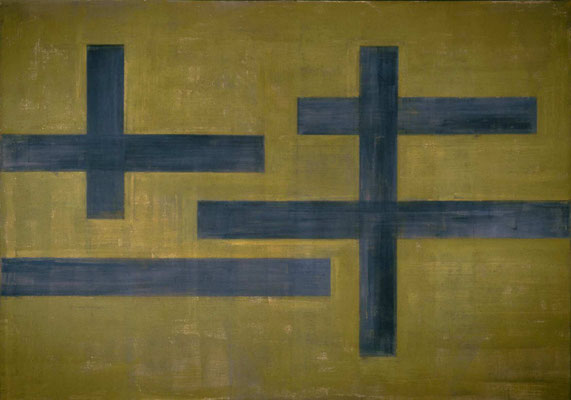
The Fayum Portraits, Cimabue's Crucifix in Assisi, Giotto's The Kiss of Judas and Saint Francis Preaching to the Birds, Masaccio's The Expulsion of Adam and Eve from the Garden of Eden, Piero della Francesca's The Dream of Constantine and The Flagellation of Christ, Michelangelo's Slaves; Giorgione's The Tempest, Pietro Longhi's The Rhinoceros, Ribera's The Bearded Woman, Georges de La Tour's Job Mocked by His Wife, Frans Hals's The Regents of the Old Men's Almshouse, Rembrandt's self-portraits, Goya's The Dog, James Ensor's Christ's Entry into Brussels, Munch's The Starry Night, Manet's The Dead Toreador and A Bunch of Asparagus, Monet's Haystacks, Bonnard's Lunch with the Dog, Matisse's The Red Studio, Andy Warhol's Big Electric Chair, and the paintings of Philip Guston, Gilles Aillaud, Helmut Federle, among many others.
Justine: You have said that you work "against the literalness" of the Italian Primitives. How do you translate that tension into your own paintings?
Joël : No, no, you should reread my interview. I never speak about the literalness of the Italian Primitives. That would contradict everything I have been saying.
They painted episodes from the Gospels. Through great formal simplicity, they sought to express the relationship between everyday life and the beyond, the very opposite of literalness.
Many painters today work figuratively. But simply translating an image into paint is not enough if the passage into the materiality of painting does not produce a kind of surplus of meaning, something suggested, intuitive, felt. Otherwise, one remains within the realm of cultivated, skilful and seductive craftsmanship: a contemporary form of academicism.
I believe one has to search behind the painting, to make it say something other than what it shows.
Justine : In what ways has your painting practice shaped or deepened your thinking?
Joël: I am not an academic. Reflection does not come before practice, I think through making. Intuition (which is a form of fluid, unfixed thought) develops alongside the work itself. The two move forward together.
My reflection comes afterwards. It grows out of looking back at my paintings and trying to understand what I have done, what I was searching for. It is a fragmented reflection, one that unfolds from one painting to the next.
It also develops through encounters with things outside the studio: texts, images, and other works of art, whether contemporary or historical, that deepen my understanding.
Each painting is an answer, or an attempt at an answer, to the world we live in today. It is an interface with that world.
What I see, however, is a growing lack of interest in the work of form, whether in art, literature or cinema, in favour of academic storytelling and its consensual messages. It reflects a retreat of poetic language, whose meaning is never fixed, and, with it, a retreat of uncertainty and imagination.
Justine: You have referred to Pasolini and his essay on the disappearance of the fireflies. What is it about that text, or about his way of thinking, that resonates so strongly with you?
Joël: As early as the 1960s, Pasolini was writing about the spread of mass culture as a consequence of economic liberalism and the global circulation of commodities. The same commodities everywhere on the planet.
Culture itself has become a commodity, the same for everyone, manufactured according to the same formulas, making works of art ever more immediately accessible, requiring no effort.
There is a continuous, international flow of images and sounds that captures our attention and pushes aside anything unexpected, different, or demanding.
For Pasolini, the disappearance of the fireflies symbolised the erosion of traditional cultures rooted in particular places, the disappearance of peoples with their own identity and language. (He even wrote in the Friulian dialect.)
That is why I believe we must reclaim images, inhabit them, and divert them from their intended purpose by clothing them in poetry and suggestion.
Justine: How do ideas drawn from literature, cinema, or philosophy resonate with your painting practice?
Joël : Answering that question follows directly from what I was saying before.
I am drawn to artists who take their time, who are unconcerned with narrative continuity, who are not afraid of losing us, of immersing us in their own world. It is those artistic attitudes that influence me more than ideas themselves, because ideas belong to everyone, everyone ends up thinking the same things.
So it is not at the level of ideas that things happen, but beneath them, behind them, in the spaces between them. It is like inventing a language that we do not entirely understand, yet one that reveals another aspect of the world to us.
Of course, one has to be available for that kind of experience. Just as one must be available to read Faulkner or Jon Fosse, or to watch the films of Nuri Bilge Ceylan, Eugène Green, or Bi Gan.
Artists cited by Joël NRisse during this interview





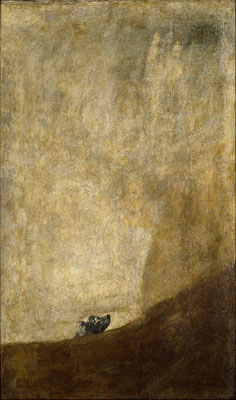
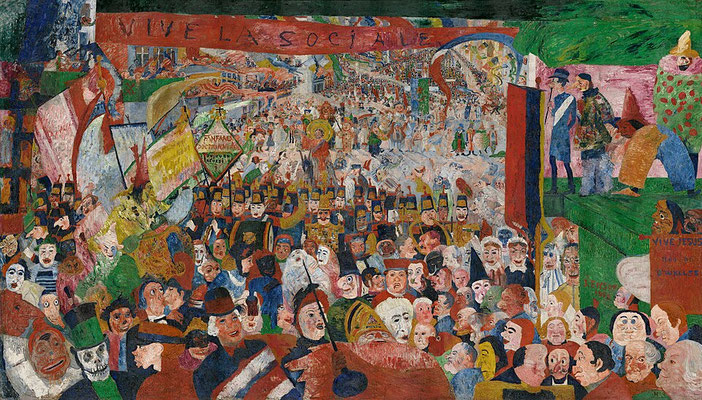
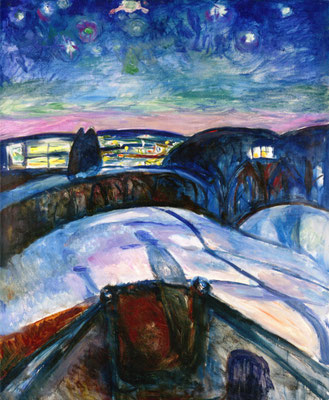

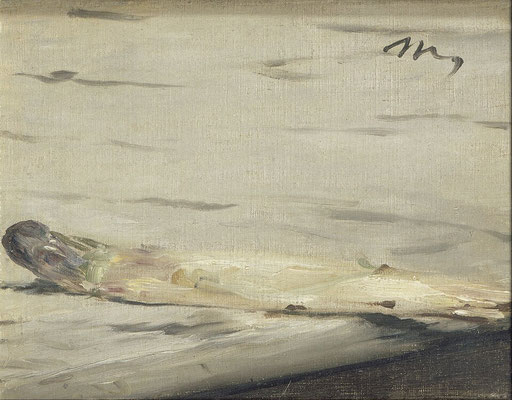



Conversation between the Artist Joël Brisse and the Gallerist Catherine Pennec end of 2025
1. The title of the exhibition
Catherine : “Le Jardins des Oliviers” (“The Garden of Olives”) is a title that immediately resonates with the biblical story and Jerusalem. Is it a spiritual or symbolic reference?
Joël Brisse : First of all, it’s a pictorial reference, Mantegna for example. Three figures lying at the bottom of the painting and one standing higher up, facing the landscape. I tend to leave Christ out, to disrupt the reference. So there is a void in his place, and below, three unconscious figures since they are asleep. I feel that this strengthens the mystery, since Christ is a kind of answer. And that corresponds to my own thoughts: I don’t know if God exists or doesn’t exist, in front of me there is only emptiness. And of course, there’s also the biblical echo: this place of waiting, doubt, and solitude. The olive tree is also a tree of memory, of resistance (let’s not forget it was once called Palestine), of light. The garden becomes a metaphor for what concerns me in painting: a closed space where the image becomes denser.
Catherine : You also made a short film titled Les Oliviers in 2013. Is there a link between that film and this exhibition?
Joël Brisse : Yes, there’s a secret thread between the films and the paintings. The enclosed space is that of the tale, and the tale flirts with metaphor. The Mediterranean landscape is a setting for the two characters, much like in my painting where the subjects are often centered, as if enveloped by the space of the canvas. And there is the idea of return in Les Oliviers—the characters meet again and share stories. In my films, there is often a story within the story. This exists in painting too: a reference to the one that came before, from painting to painting in the painter’s journey, and also within an historical lineage. I clearly see a contradiction there: embracing a reference while also trying to blur it.
2. A double practice : painting and cinema
Catherine : You are both a painter, a screenwriter, and a filmmaker. How do these practices nourish one another?
Joël Brisse : What’s certain is that when I write a script, I have to see—it isn’t conceptual. I must see the characters, the places. After that, it’s all about compromise with the realities of filming. The narration progresses through events, small or large, which influence the following ones. In painting, I want people to feel that it tells something but not know what—that it’s an unutterable story. The subjects, immobilized in the material, often seem to be asking themselves what they are doing there. Perhaps they rub off on the characters in my films, who are indecisive, unstable, caught between two states (which is part of their strangeness). And when they do make a real decision, it can turn into a general blaze, as in La fin du règne animal.
Catherine : Your paintings are often large-scale, while your films are short films. Why this contrast in formats?
Joël Brisse : They can neither truly be compared nor opposed. Time is not the same. Time in painting is a revealed time, suspended, potential. It is the presence of what creates the image (even in abstraction) that gives the sensation of time. It’s there, it imposes itself on us, but it cannot be grasped. You see it all at once, yet it cannot be described, much less undone. Time in cinema runs away—you chase after it like a dog after a ball. And even when the rhythm slows, when nothing seems to happen, we feel time within us. It’s like reading or listening to music—you are carried through it. Unlike with painting, there’s no time to be looked at by the image.
3. Roots and territory
Catherine : You were born in Vichy, studied at the Beaux-Arts in Clermont-Ferrand, then lived for many years in Paris before settling in the Gard. How have these places shaped your path?
Joël Brisse : In Vichy I often wandered along the banks of the Allier, where the gaze escapes horizontally—it’s not a town where you sense labor, unlike Clermont, where you have to lift your head toward the Auvergne mountains to escape the Michelin factories. That’s where I understood that painting wasn’t just a pastime but a commitment within my reach. I absorbed every form and image I could at art school but also in all the city’s film clubs, especially that of the faculty of letters, which later became the Short Film Festival. Paris offered me decisive encounters, emulation, important exhibitions. And the Gard, today, is a refuge—a landscape, a light that nourishes my painting, but also a fertile distancing.
Catherine : The Musée Roger-Quillot and the FRAC Auvergne hold some of your works. Is it important to you that Clermont, your birthplace, keeps an institutional trace of your work?
Joël Brisse : Yes, of course, that too is a kind of return. It means that this territory, which saw me born and grow artistically, recognizes my work. It’s a precious continuity. But I give just as much importance to other collections elsewhere.
4. Artistic journey and vocation
Catherine : Where does your vocation as a painter come from? Were there artists in your family?
Joël Brisse : None at all—my grandparents were farmers in the Bourbonnais mountains, my father was a mechanic, and I had a zigzagging education, from remedial classes up to the baccalauréat. But I drew very early on, and I think I was fairly good at it, though no adult ever encouraged me in that direction. With drawing I needed no one—just a sheet of paper, a pencil to build a small world, to make something exist that didn’t exist. Quickly I thought there was no alternative—I couldn’t imagine working just to make a living. And what’s incredible is what happened after.
Catherine : And cinema—what led you to writing and directing starting in 1997?
Joël Brisse : I live with Marie Vermillard, who makes films. We’ve been together so long that you could say we grew up together. Naturally, we share a lot. We co-wrote her first scripts. But my involvement in cinema stopped there. Then she refused one of my scripts, and suggested instead that she help me film it. That film was called Les pinces à linge. And we kept going like that—me writing with her, her helping me with the shoots.
Catherine : Why did you choose to focus on short films?
Joël Brisse : Ah, there are several reasons. The short form suits me. You can’t say everything—you must convey the stakes, dramatize tiny things, stretch time until it resembles real time. You can caress a landscape or put actors in the dark and hear only their breathing, just a simple moment between them. A gesture can evoke their whole life. The short film is still very close to cinema’s origins—inventive, daring, poetic. Because cinema is also an industry, with commercial constraints even at the script stage. It’s difficult to remain free when you must tell a story with subjects, a tone, and a format calibrated to fill theaters.
5. Painting : formats, techniques, and approach
Catherine : You excel in large formats. Why do you feel more at ease on that scale?
Joël Brisse : I don’t like to just recite my lesson when I enter the studio—I like to be in a risky situation, asking myself how I’ll get through it. The large format allows me to be on equal terms with the canvas (a body-to-body encounter). It also means I can’t impose on it what it refuses—I must come to an agreement with it. There must be flow, even when everything seems in place. At some point it sets (like plaster), it’s there, and it surprises me.
Catherine : What techniques do you favor for your canvases?
Joël Brisse: For a long time I’ve painted in oil. It is less flexible to use, but it doesn’t contract when drying and long afterwards it looks as if it had just been applied. I also dislike when the surface shines and catches light reflections, so I use very little medium. Not many transparencies—the color is compact. No effects, no unnecessary textural research—the simplest, the basics of the technique.
Catherine : You once said that you work “against images, against their literality.” Could you expand on that?
Joël Brisse : Yes, I often start from one or several documents, but I try to go beyond the source images. I attempt to decontextualize them through formal work, in a raw, frontal manner, without effects, with a kind of deliberate clumsiness that gives them strangeness—as if they were caught in a mute zone, a kind of primal poetry. What matters is what escapes, what remains unsaid or unsayable. When I say it should set like plaster, I mean that suddenly it becomes silent. Silence is what creates intimacy with the viewer, and at the same time keeps them at a distance, makes them lose their footing in familiar terrain. That’s what removes painting’s literal (trivial) aspect, what makes the image resonate—I’m searching for something that lies behind the painting.
6. Looking toward the current exhibition
Catherine : What will the public discover in “Le Jardins des Oliviers”?
Joël Brisse : Canvases that question both memory and the present, beauty and unease. The living and the absent. This garden is an inner place, but also a collective one.
Catherine : What would you like visitors to take away from encountering your works?
Joël Brisse : It would be wonderful if painting could be an antidote to the madness of the world, to materialism, to the violent exhibitionism of social media, to frenetic consumption—the chance to listen to one’s inner silence. I feel like a naïve man without illusions who wants to promote a return to innocence.


La Galerie Catherine Pennec est une galerie d'art contemporain nichée au pied de la Cathédrale de Clermont-Ferrand en Auvergne. Elle présente des artistes émergents et confirmés à travers des expositions de peintures, sculptures, broderies, verreries, céramiques, photographies artistiques et installations.
réalisation du site : nivoit-multimedia.com