
Théo Beaumont (1990)

Contemporary glass artist exhibiting at Galerie Catherine Pennec in Clermont-Ferrand, Auvergne (France)
Biography
Born in 1990, Théo Beaumont is a glass artist whose unique path blends scientific rigor, artistic sensitivity, and fascination with material. Trained in scientific glassmaking from adolescence, he began at 14 at the Lycée technique Dorian in Paris, where he obtained a CAP (2007) and then a Bac Pro (2009). His passion for glass took root during a decisive summer in 2004, spent in the workshop of glassmaker Ludovic Guittet, in Le Bugue (Périgord).
Very early on, he was encouraged and guided by several major figures in the field of glass, including Ludovic Guittet, Alain Villechange, and Jean-Pierre Baquère. These encounters helped him refine a vision in which the pursuit of purity, technical curiosity, and aesthetic demand intertwine. For him, glass is a paradoxical material: impossible to grasp yet extremely responsive to gesture. His practice resembles an exercise in balance, attentiveness, and serenity.
Having lived for several years in Lyon, after collaborating with Atelier Morfia founded by Laurence Pétré, he opened his own workshop in this city, whose textile history deeply influences his work. From 2014 onward, he developed his first personal creations, using fine threads of flameworked glass. This material, initially conceived as an ornament, became the foundation of his artistic research.
The “Textiles”
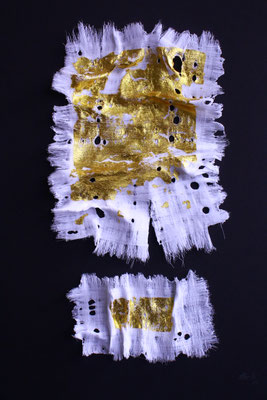
From this experimentation emerged the Textiles collection, where glass, stretched to the thickness of a hair, composes suspended weaves. These false fabrics, made entirely freehand, evoke ancient relics, fragments of memory, or shroud-like imprints. They are presented as tableaux, where light and glass engage in a fragile dialogue. Théo Beaumont creates the illusion of weaving by layering these perpendicular threads and then fusing them in the flame of a torch—rather than in a kiln—to give them a more organic and timeless dimension.
Urban Primitive
More recently, he has embarked on new research with the Urban Primitive series. In this body of work, he explores the relationship between matter and architecture by reversing the codes: glass becomes structure, while concrete—paradoxically fragile and poetic—is deposited upon it. These pieces reflect his vision of the city, a raw and hostile space but also one searching for hospitality.
A Signature
The son of a photographer, Théo Beaumont inherited from his father the “know-how of the instant,” the ability to capture the fleeting nature of a gesture or a moment. His works bear witness to this attention to detail and openness to the world. Influenced by urban art, graffiti, traditional crafts, and music, he grounds his research in two guiding principles: the repetition of gesture and the elegance of a line.
Today, based in Lyon, he continues to develop a practice where technique and poetry intertwine. His signature: a pure line, precision of gesture, and a rare ability to make the transparency of glass converse with the suppleness of textile, the urban with the intimate.
Exhibitions
2025 | CONDRIEU | “Biennale du Verre” | La Chapelle de la Visitation
2024 | LYON | “L’Eau à la Bouche”
2024 | TROYES | “Tressages” | Galerie Artes
2022 | LYON | “Textiles” | Biennale de Lyon
2020 | LYON | “Autour d’un fil” | Éclat de Verre
2019 | BACCARAT | “Festival de Verre au chalumeau”
Théo Beaumont's pieces of art


Interview between Théo Beaumont and Catherine Pennec
1. The artistic career
Catherine Pennec: Theo, thank you for being with us today. We are going to talk about your career and your work, which will soon be presented in our exhibition En découdre, regards croisés sur le fil. To begin with, can you tell us how you came to the glass?
Théo Beaumont: With pleasure. I started very young, at 14 years old, at the Lycée technique Dorian in Paris. I obtained a CAP and then a Bac Pro in scientific glassmaking. But my passion was born a little before, in 2004, when I spent a summer in the workshop of Ludovic Guittet, in Périgord. I discovered an elusive material, demanding, but incredibly responsive to the gesture. It was a revelation.
C.P.: And you met several important figures from the glass industry on your way?
T.B.: Yes, absolutely. Besides Ludovic Guittet, I had the chance to meet Alain Villechange and Jean-Pierre Baquère. Each of them gave me something precious. They taught me to seek a balance between technical rigor, attention to detail and artistic sensitivity.
C.P.: So you come from a scientific background. How did the transition to a more personal artistic approach happen?
T.B.: For a long time, I worked in a strictly technical environment. But in Lyon, by joining the Morfia workshop, founded by Laurence Pétré, I discovered another relationship with glass. Then I opened my own workshop. That’s when I started to explore my own desires and researches, especially around the textile illusion.
2. The world of textiles
C.P.: Precisely, why this fascination for fabric, and especially for the dishcloth?
T.B.: Lyon has a very strong textile history, and it influenced me. At first, I used glass yarn to decorate my blown pieces. Then I had the idea to work on them as a separate material. The dishrag interests me because it is a humble, everyday, almost banal object. Made of glass, it becomes frozen memory, fragile and precious. There is a tension between the familiar and the strange.
C.P.: We imagine that it’s also a technical challenge.
T.B.: Yes, a permanent challenge. The glass thread is extremely thin, sometimes as fine as a hair. It breaks very easily, which makes true weaving impossible. Then I create a weft illusion by superposing the threads perpendicularly and fusing them to the flame of the torch. Fire is demanding, but it forces me to be attentive, to remain in a form of appeasement.
C.P.: Have you ever exhibited in the textile industry?
T.B.: No, this will be my first time in the textile world.
3. The dialogue
C.P.: In En découdre – quatre regards sur le fil, you will have a dialogue with Lou Salamon, who embroiders “dirty critters”, Stefano Bianchi, who photographs mops and Vicario who paints on rags. How do you perceive this dialogue?
T.B.: What brings us together is our view of modest everyday objects. Lou plays with humor and irreverence, Stefano sublimates the mops with images, and I freeze glass cloths, Vicario uses the cloth as a support. Together, we shift the gaze: we show beauty in what is usually considered banal, even repulsive.
4. Inspirations
C.P.: You work in Lyon, in a shared workshop. What does that bring you?
T.B.: It’s a living space, made of exchanges. Being surrounded by other creators stimulates me, it’s a breath. It nourishes my research.
C.P.: What universes nourish your work, outside the workshop?
T.B.: Music accompanies me a lot, from Hip-Hop to Metal, passing through Reggae or even classical music, it sets the rhythm of my movement. I am also very influenced by tag and graffiti. I like this raw energy, the immediate relationship to gesture and line. I’ve been in the shadows myself for years, “I’m quite obsessed with repetitions.”
C.P.: Your father is a photographer. Is there a connection between his art and yours?
T.B.: Yes, he taught me the “know-how of the moment”, the ability to freeze a gesture, a moment. That’s exactly what I’m looking for with glass: to grab something fleeting and suspend it in time.
5. The last word
C.P.: And what do you want for this exhibition in particular?
T.B.: For this exhibition, I would like to share a new facet of my work and especially of my plastic approach with the material that is close to my heart: GLASS!
C.P.: Thank you, Théo. We can’t wait to discover your pieces at the gallery.
T.B.: Thank you, Catherine. Thank you for this opportunity to present in your gallery! See you soon.


La Galerie Catherine Pennec est une galerie d'art contemporain nichée au pied de la Cathédrale de Clermont-Ferrand en Auvergne. Elle présente des artistes émergents et confirmés à travers des expositions de peintures, sculptures, broderies, verreries, céramiques, photographies artistiques et installations.
réalisation du site : nivoit-multimedia.com