
Lydie Bonnaire (1966)
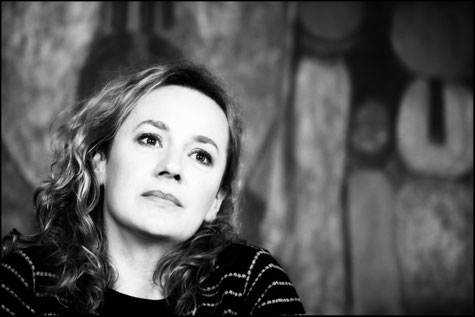
Contemporary painter exhibiting at Galerie Catherine Pennec in Clermont-Ferrand, Auvergne (France) in March and April 2026
Biography
A self-taught artist, Lydie Bonnaire has been drawing and painting since childhood, developing a practice shaped by intuition and emotion. A decisive turning point came in 1987, when a chance encounter on the set of Puccini’s La Bohème introduced her simultaneously to opera and oil painting. Deeply moved by Barbara Hendricks’ voice and captivated by Marcel’s studio, she received her first box of oil paints, with which she created The Death of Carmen.
Alongside her pictorial work, Lydie Bonnaire works as a costume designer in cinema. This ongoing dialogue between still image and moving image informs her artistic language: film deeply influences her use of colour, light and framing — an influence particularly evident in her portraits.
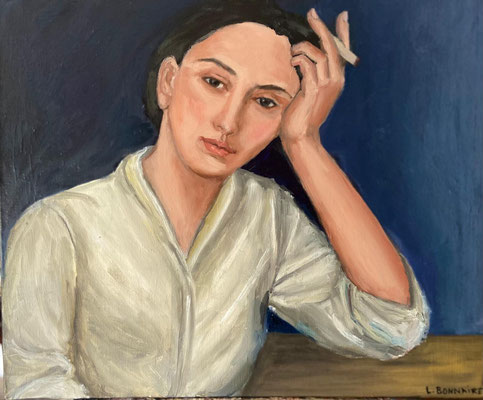
Her work focuses primarily on female portraiture, often inspired by early twentieth-century photographs. Through these timeless figures, each canvas creates a space of quiet contemplation, where the gaze of the subject meets that of the viewer, weaving an intimate and suspended connection.
Her approach is free and instinctive, guided by a search for sincerity. Each painting becomes a site of inner listening, where emotion takes precedence over narrative, allowing a presence both fragile and resolute to emerge.
Solo Exhibitions
2026 | CLERMONT-FERRAND | "Face à Face" | Galerie Catherine Pennec
2025 | VINCIENNES | Espace culturel Cœur de Ville, Vincennes
2021 | PARIS | Christine Lacour (exposition privée)
2019 | PARIS | Galerie Chappe
2017 | PARIS | Galerie Gaëlle M
2016 | CÉLESTAT | Galerie La Ligne Bleue
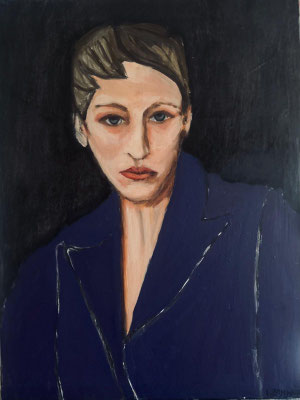
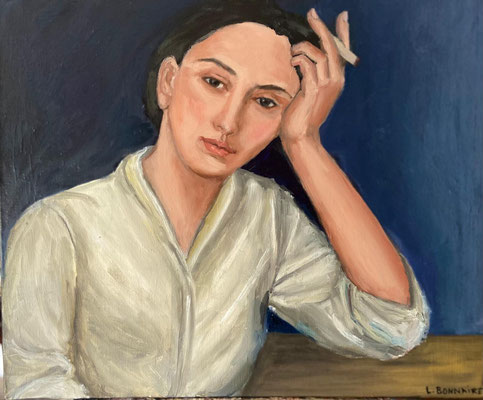
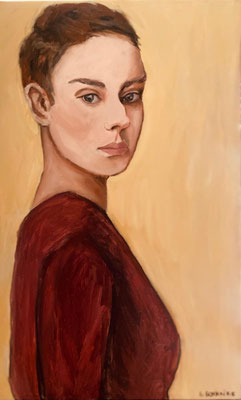

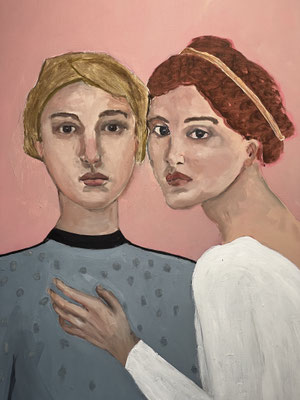
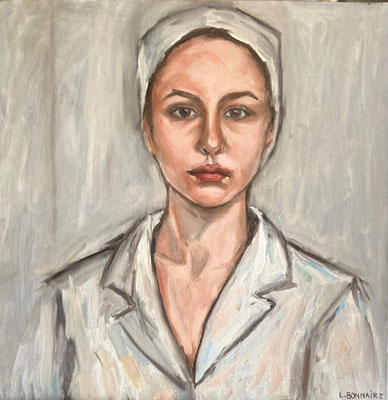
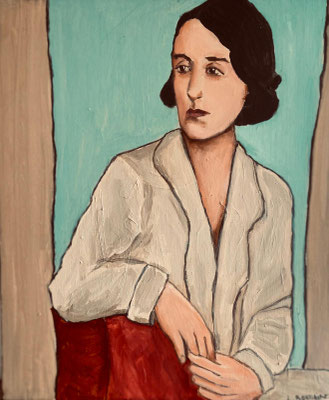

Lydie Bonnaire's pieces of art, from exhibition "Face à Face", available at the gallery
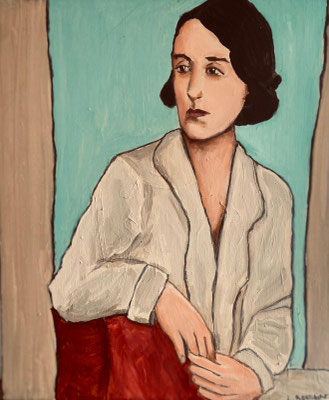

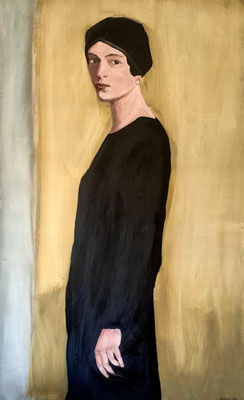
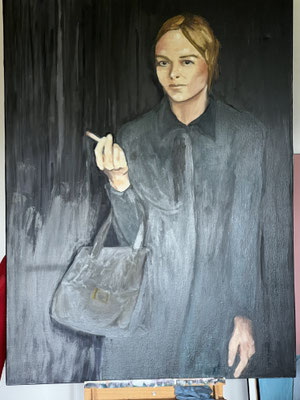
Conversation between Catherine Pennec and Lydie Bonnaire - February 2026
Catherine Pennec
Your artistic practice seems to have developed over a long period, almost underground. How did this early relationship with drawing and painting begin, and how did it evolve to become central in your life?
Lydie Bonnaire
Yes, indeed over quite a long period, as it dates back to childhood.
Children, in any case, draw a great deal naturally at home and at school. For my part, it was in a very small village school in the Puy-de-Dôme: Champs. I loved coloured pencils and erasers.
Later, I enjoyed borrowing my father’s newspaper, which contained fashion sketches and drawings that I would try to reproduce.
It was also a way for me to withdraw, moments of solitude, especially when growing up in a large family.
Painting came later and truly imposed itself as a powerful means of expression.
I think the underground aspect was mainly that I had no choice. Like everyone else, I had to work to support myself, and painting existed alongside this rather than underground.
Today, at my age, I am finally discovering that selling my paintings can also help support me.
Catherine Pennec
You often refer to the year 1987 as a founding moment, during the filming of La Bohème by Puccini. What happened for you at that moment? And how do you explain that painting imposed itself at that precise point in your journey?
Lydie Bonnaire
In 1987, I was meant to join a friend on the film set of La Bohème. When I arrived in the courtyard of a building that had been entirely dressed for the film, I witnessed a rehearsal by Barbara Hendricks and José Carreras, both wearing period costumes. As I passed through that doorway, I felt transported into the past and was deeply moved by the singers’ voices.
Then I was invited up to the top floor of the building, where another set had been constructed: a painter’s studio. I cannot explain it, but something familiar emanated from that atmosphere — I felt at home.
At the end of the shoot, to my great surprise, I was given all the props and tubes of oil paint that had been used for the set.
That very evening, at home, I found myself painting, despite having no technical training whatsoever. I painted all night, and it was a revelation.
Catherine Pennec
Your dual activity as a painter and costume designer creates a singular dialogue between still and moving images. How does cinema nourish your painter’s gaze? What does it bring to your approach to light, colour, or composition?
Lydie Bonnaire
There is certainly a parallel, because of course, in film preparation as well as during shoots, the notion of image, colour, and light is fundamental. Even though there is an artistic direction, imagination, when reading a script, is essential to the creative process. As far as I am concerned, cinema is connected to what the actors will embody and the emotion that results from it. That is my main vision, which may nourish my painting, along with the costume, which defines the characters.
Catherine Pennec
Your portraits often draw on photographs from the 1920s and 1930s. What attracts you to this period of the Roaring Twenties? What do these faces from another time represent for you?
Lydie Bonnaire
I have always loved old photographs, not only those from the Roaring Twenties.
I think it relates to the transition between painting and early photography. I am absolutely fascinated by the relationship subjects had with the photographer’s lens.
There was something sacred about it — moments that capture time, an era, an instant. All those people have now disappeared, of course, but I have always wondered what their lives were like, how they spent their days, whether they were happy, and above all, their gaze.
Catherine Pennec
Why has portraiture become your privileged territory of exploration? What does this form allow you to express that other genres might not?
Lydie Bonnaire
I have always loved portraiture. In great museums, I admire portraits from all periods. It relates to what I said about photography — it is a direct contact with the viewer, an exchange through the gaze of someone who existed or did not exist. It is an encounter.
A face-to-face, like the title of the exhibition — but also a face-to-face with myself as I paint it.
Catherine Pennec
What are your artistic influences, in painting as well as photography? Are there artists or ways of seeing that have accompanied you over time?
Lydie Bonnaire
In photography, I greatly admire Auguste Sander, among others, and Sarah Moon.
In painting, Van Gogh’s portraits are very raw and alive.
Also the colours in Klimt, Gauguin, and Matisse.
Catherine Pennec
Music seems to be a constant presence in your creative world since your discovery of opera. What music accompanies your work in the studio today?
Lydie Bonnaire
Yes, music is very present — indispensable when I paint. I mainly listen to classical music, and I find that the harpsichord is completely transcendent when accompanying the creation of paintings.
Catherine Pennec
And in literature, what readings nourish your imagination or sensitivity?
Lydie Bonnaire
I generally enjoy novels — Balzac, Maupassant, and also Stefan Zweig, whose writing is very visually rich.
Authors from Eastern Europe, such as Kundera, appeal to me greatly. More contemporary writers include Amélie Nothomb and Emmanuel Carrère.
Catherine Pennec
Can you describe your creative process? Where does everything begin — with an image, an emotion, an inner resonance? How does a painting take shape?
Lydie Bonnaire
It is never quite the same. It can be a light on a landscape, walking in a forest, a dream, a piece of music, an image — which then becomes an absolute necessity to transpose into colour on canvas.
Catherine Pennec
Your painting is distinguished by the softness of skin tones, the depth of gazes, and a certain economy of means. How do you work with material and colour? What place does intuition occupy in your technique?
Lydie Bonnaire
I allow myself to be guided primarily by intuition and emotion. I never know exactly, from the first charcoal lines, where I will end up. The portrait comes to meet me little by little, and sometimes ends up very far from the initial work. Being self-taught leaves a great deal of space for feeling.
I do not prepare my palettes in advance. I may imagine a range of colours at first and then completely move away from it. It is not improvisation, but intuition and emotion.
For this reason, my portraits are very different from one another.
I mostly work in flat areas of colour. What matters to me objectively is the face and expression, though I sometimes venture into patterns and ornamentation.
Catherine Pennec
What would you like to convey to the public through this exhibition Face to Face? What experience do you hope visitors will have?
Lydie Bonnaire
Ultimately, I would like something quite simple — authentic. That is to say, an encounter with the portrait, and perhaps a dialogue through gazes.
I know that melancholy emerges from my portraits. I think we all carry within us a certain form of melancholy, wherever it comes from.
Looking at the sky or the landscapes of Auvergne, a tender mother — these can bring that hint of melancholy into one’s eyes.
This is surely why I love old photographs so much — family albums yellowed by time, found in antique markets. The passage of time moves me deeply.
And to quote this beautiful phrase by Freud: “Melancholics are people who are ill with truth.”
Catherine Pennec
Do you envisage exploring other media in the future — photography, sculpture, installation — or does your research remain deeply rooted in painting?
Lydie Bonnaire
Yes, it interests me greatly, particularly combining painting and photography, using layering techniques, collage with other materials such as sand, plants, or wood.
Catherine Pennec
In your view, what is most precious in the life of an artist? And conversely, what can sometimes be most disorienting or fragile?
Lydie Bonnaire
What is precious in the life of an artist is to be an artist.
It is an extraordinary privilege to be able to create. What can be most disorienting is perhaps what is called the blank page syndrome — a lack of inspiration that can be paralysing.
As for what is most fragile, it remains that life — and the choice to be an artist, especially in our time — is quite difficult. Trying to live from one’s art is no small matter. That is where the fragility lies.
For me, an artist is not fragile — on the contrary, they confront the world with courage.
Catherine Pennec
To conclude, if you had to summarise your approach today in a few words, what would they be?
Lydie Bonnaire
I do not know if I have a particular approach. What is essential for me is to paint, to tell stories through portraits. To tell myself stories. And to hope that perhaps some people may understand them, and share them in turn.


La Galerie Catherine Pennec est une galerie d'art contemporain nichée au pied de la Cathédrale de Clermont-Ferrand en Auvergne. Elle présente des artistes émergents et confirmés à travers des expositions de peintures, sculptures, broderies, verreries, céramiques, photographies artistiques et installations.
réalisation du site : nivoit-multimedia.com