
Simon Blau (1970)
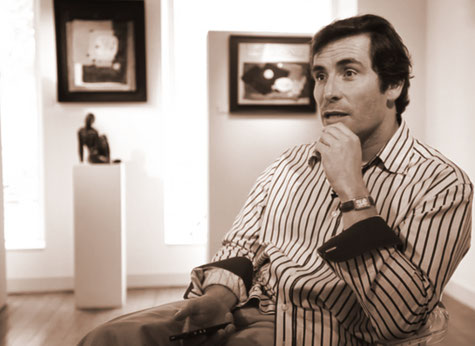
Contemporary painter exhibiting at Galerie Catherine Pennec in Clermont-Ferrand, Auvergne (France) in May and June 2026
Biography
Paraphrasing Tennessee Williams, Simon Blau states that painting is a commitment to himself and that he has no other alternative. His work as a painter is a mode of existence, a form of escape deeply rooted within him.
Born into a family of artists, painting naturally imposed itself upon him as the most immediate path for expression, like a native language composed of brushstrokes, colours, lines and forms, syntactically assembled and staged to present something born of wonder and questioning.
His pictorial research explores the inner and the beyond, limits and infinity, openings, horizons, suspension, the moment, reproduction and its corollary — mimesis — as well as the human being as a source of knowledge and the reason for its own perceptual disappearance.
His painting, imbued with dreamlike and even philosophical qualities, is above all an invitation to the realm of possibilities. The artist prefers to leave doors open, confronting, sometimes to the point of absurdity, dissonant dreams within his work.
Beyond this conceptual approach, Blau remains deeply attached to form and prefers to leave meaning to each viewer’s intimate interpretation. Reducing a work to the words of commentary can sometimes silence its inner eloquence; thus, he prefers to let whisper the “inner life of things” evoked by Bergson, allowing the silent life of the “actors” within his scenes to emerge, and to speak instead of the sensory experience inherent in the act of painting.
In the act of painting, he remains attentive to sensation: he enjoys sensing the smell of colour, the resonance of tonal values, listening to the “little phrase” of forms, caressing the material, brushing the surface, probing it through gesture, and remaining receptive to the moment.
For him, painting is a complete way of being in the world — at once futile and essential.
Simon Blau is a former student of the École des Beaux-Arts and the recipient of numerous awards, including that of the Institut; he practises his art discreetly, far from the tumult.
List of Exhibitions (non exhaustive)
2026 | PARIS | "Sommeil et Terre" | Galerie Maison Jaune
2025 | LUGARDE | "Notes de Voyage" | Galerie Palmyre Pétrovich
2025 | LUGARDE | Galerie Palmyre Pétrovich
2024 | LUGARDE | "Invariants" | Galerie Palmyre Pétrovich
2024 | MENDE | "Balcons" | Galerie Séraphine
2024 | LUGARDE | "Dédales Étoilés" | Galerie Palmyre Pétrovich
2024 | CAEN | "Vies bleus et étoilées" | Galerie 170
2023 | LUGARDE | Galerie Palmyre Pétrovich
2023 | LA MOTTE SERVOLEX | "Matera" | Galerie Épicerie
2022 | LUGARDE | Galerie Palmyre Pétrovich
2019 | LUGARDE | Galerie Palmyre Pétrovich
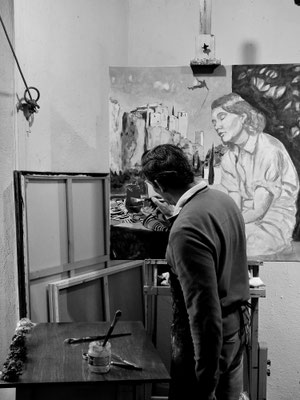
Simon Blau in his studio
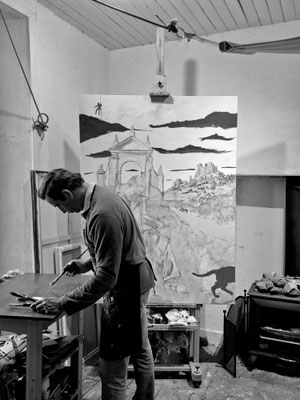
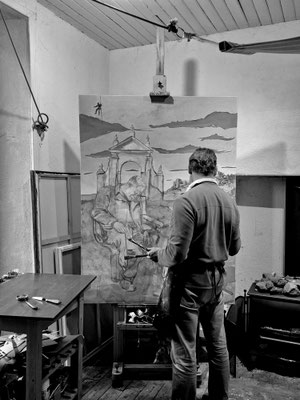

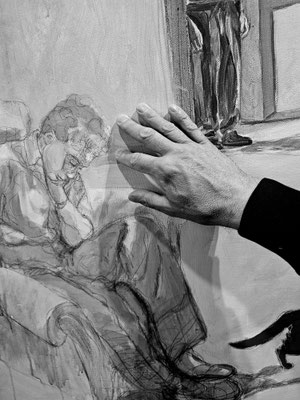
Oil on Canva

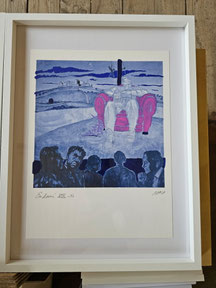
Gouache

Drawings
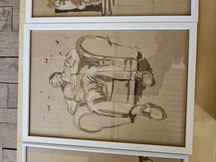
Variations
Conversation between gallerist Catherine Pennec and artist Simon Blau— 26 February 2026
1. Painting as a vital necessity
Catherine: Simon, you say that painting is a commitment to yourself, almost without alternative. At what moment did you realise that painting would become your way of being in the world?
Simon: I was born into an artistic environment, so this way of being in the world was present from my earliest years, although I was not fully conscious of it at the time. However, an ineffable “je ne sais quoi” made me feel somehow out of step with a profane world impermeable to my meditative reveries and aesthetic inclinations. It was during adolescence that things began to take shape: drawing and painting appeared to be the most natural means through which I could most adequately persevere in my being.
Catherine: For you, is painting an escape, a form of resistance, or a way of fully inhabiting reality?
Simon: The first thing that comes to mind is that it is a protective and enchanted refuge in which I find great serenity; time and space dissolve within action and inwardness. In this sense, one might see it as an escape from the external world — an escape that is nonetheless necessary. I do not think of it as resistance, because resistance implies being against something, which is not the case for me. I prefer to nourish myself from the world and find contentment within myself. Fully inhabiting reality is a vast undertaking that belongs only to Nature. Without adopting a solipsistic conception of things, we are merely instances of reality inhabited by affects and subjectivity. It is also true that, as artists, we possess organs that allow us to sense the inner life of things when the light is right and the winds are favourable — yet what it means to grasp reality, I do not know.
2. A native language
Catherine: You speak of painting as a language made of touches, colours and forms. How has this language developed over time?
Simon: If we are speaking of the plastic register, it is the result of constant and patient maturation, of questioning what has already been acquired. Like any language, we begin with elementary syntax and vocabulary, then over time enrich and refine our expression — not to demonstrate technical skill, but because it is above all a matter of pleasure and delight in discovery.
Catherine: What can painting express that words fail to formulate?
Simon: The ineffable — it is the song of sign and emotion. Where the empire of words ends, that of the image begins.
3. Suspension, thresholds and horizons
Catherine: Your works often explore limits, in-between states, suspended moments. What draws you to these transitional zones?
Simon: These passages invite questioning. As I mentioned earlier, everything escapes us; we can grasp nothing. The question itself is beautiful and opens possibilities. This is not relativism, since there are, for example, factual truths derived from the scientific corpus. However, those who claim to hold definitive answers frighten me.
4. The painter’s sensitive body
Catherine: You describe the act
of painting as a total sensory experience: the smell of colour, the sonority of tonal values, the caress of matter.
Is painting above all an act of the body before it is an act of thought?
Simon: I would say both, as far as my work is concerned. I reflect beforehand in order to better free the hand in the act of painting. Afterwards comes letting go in relation to gesture and sensoriality. Ideas may also arise from this emotional relationship with the world, which is permanent.
5. Meaning and silence
Catherine: You are wary of overly explanatory discourse surrounding artworks. Why is it important for you to leave meaning open?
Simon: I believe everyone should be left to their own subjectivity, their feelings, even their modesty. I am neither a spiritual guide nor a guru — I present something to be seen: do with it what you will.
Catherine: What do you think silence brings to painting?
Simon: There is, in fact, no silence; painting is sonorous — lines and colours vibrate in unison.
Catherine: You have chosen to live somewhat apart, in the magnificent département of Cantal. What does this place bring you?
Simon: The calm I mentioned at the beginning of our conversation, and an inexhaustible source of light, lines, colours and atmospheres.
6. The visible and the invisible
Catherine: Your scenes seem inhabited by an “inner life of things.” How do you allow this silent presence to emerge?
Simon: On this point I try not to think. I attempt to be the partial and biased intermediary of a free Nature; here, gesture is decisive in its full contingency.
Catherine: The human figure is central in your work, yet often threatened with disappearance or frozen between two states. What does this say about our time?
Simon: You speak of disappearance or transience in my figures; I also speak of incompletion — of capturing a becoming, or opening onto the field of possibilities. What interests me in the human being is the existential relationship to life, absurd and derisory. There is no anchoring in current events nor in our era.
7. Influences and invisible nourishment
Catherine: What music accompanies your work in the studio?
Simon: I cannot listen to music while working; it is either silence or literary, philosophical or scientific broadcasts.
Catherine: Are there philosophers, writers or artists who have shaped your way of seeing and painting?
Simon: Naturally, I have been influenced by countless artists across movements and periods. Listing them all would be long and tedious, so I prefer to leave it to the viewer to discern influences — even quotations of certain artists — within my paintings. Writers, philosophers and scientists enrich my reflections but do not directly influence my way of painting or my gaze.
9. In conclusion
Catherine: You are drawn to architectural elements. If painting were a space to inhabit, what would the one you build canvas after canvas look like?
Simon: Like my home! For years I have been developing my own setting, populated by silent lives (silence again!), openings, constructions and passages. I often work with optical boxes in order to stage a scene that also echoes my interior world. I wander both through models and through my own home, sometimes ending up inside the painting itself — the boundary between these universes can be very thin. The further I advance, the more I invest myself in my work, and the more it comes to inhabit me.


La Galerie Catherine Pennec est une galerie d'art contemporain nichée au pied de la Cathédrale de Clermont-Ferrand en Auvergne. Elle présente des artistes émergents et confirmés à travers des expositions de peintures, sculptures, broderies, verreries, céramiques, photographies artistiques et installations.
réalisation du site : nivoit-multimedia.com