
Pascale Parrein (1972)
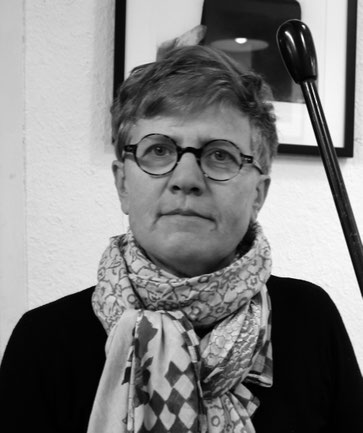
Contemporary engraver, watercolorist, painter, and illustrator exhibited at Galerie Catherine Pennec in Clermont-Ferrand, Auvergne (France) in May & June 2026
Biography
Printmaker and draughtswoman Pascale Parrein has developed, for more than twenty-five years, a distinctive body of work in which the human figure, erasure and the unease of inner states intersect. Originally from Normandy, she has been based in the Grenoble region since 2003, after living and working in Paris, Montréal and Orlando.
Her trajectory is marked by a unique dialogue between science and artistic creation. A researcher in optoelectronics and photonics, she has simultaneously pursued a demanding artistic practice. Rather than opposing one another, these two fields share a common concern with reality, its complexity and the limits of perception. This tension between knowledge and mystery deeply informs her artistic approach.
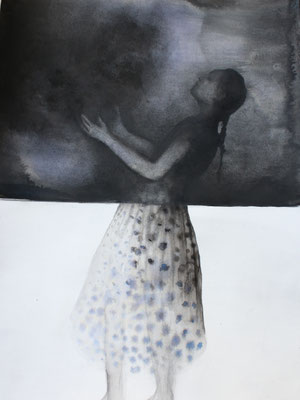
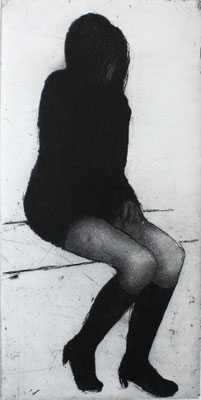
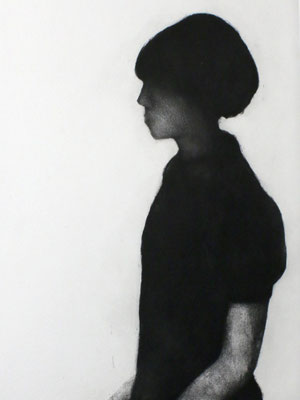
Her drawings, inks and prints – including charcoal, etching and photogravure – often depict fragile figures suspended between appearance and disappearance. Faces blur or dissolve into the material of the image, creating unstable compositions in which figuration and abstraction coexist. Through erasures, scratches and ruptures within the surface, the artist seeks to reveal the invisible dimension of reality and to evoke the fragile equilibrium of human experience.
Black plays a central role in her work. Rather than symbolising darkness, it becomes a rich field of exploration, unfolding through a wide range of textures and tonal variations. Parrein’s work seeks not spectacle but a quiet emotional resonance and a poetic intensity within the image.
Her work has been presented in numerous exhibitions in France and internationally, including major biennials and triennials dedicated to contemporary printmaking and drawing in Europe, North America and Asia. Her works are held in several public collections, including the Musée de Carla-Bayle, the Bibliothèque nationale du Québec and the Frans Masereel Centrum in Belgium.
In 2026, Galerie Catherine Pennec in Clermont-Ferrand presents an exhibition "En suspend" bringing together works by Pascale Parrein and the painter Simon Blau. The exhibition highlights subtle resonances between two distinct artistic universes, both marked by a poetic and dreamlike sensibility.
Personal exhibitions (non exhaustive)
2026 | ANTIBES | Résidence Collective avec Jim Manson et Paulo Bosi, Villa Fontaine
2023 | VOIRON | Les Intranquilles | Galerie Place à l’Art
2022 | GENÈVE | Par les temps qui courent | Galerie F. Fontaine
2021 | GRENOBLE | Un autre jour | Galerie du Losange
2019 | ANTIBES | Intimité | Galerie des Bains Douches
2019 | GRENOBLE | Errance | Galerie du Losange
2018 | AIX-LES-BAINS | En attendant… | Galerie Chappaz
2018 | CLAIX | Incertitude(s) | Le Déclic
2017 | LYON | Ressentir l’invisible | Galerie Catherine Mainguy
2016 | GRENOBLE | Les choses | Biennale du dessin de Saint-Laurent
2016 | GRENOBLE | Étrange beauté | Espace Rabot – Librairie Arthaud
2015 | GRENOBLE | Le temps de l’innocence | Artothèque de Grenoble
2015 | GRENOBLE | Errance | Galerie Alter Art
2013 | GRENOBLE | Illustration | Galerie des Beaux-Arts
2010 | GRENOBLE | (In)visible, installations interactives | CEA
2008 | GRENOBLE | Exposition | Brise-Glace
2007 | GRENOBLE | Portraits | Galerie Cupillard
2006 | GRENOBLE | Anonymes | Galerie Entr’Arts
2003 | ORLANDO (USA) | Face à Face | Timucua Lake
2003 | MONTRÉAL (CANADA) | Face à Face | Atelier Circulaire
2000 | PARIS | Précis de décomposition | Fondation Deutsch de la Meurthe
1997 | LA BOUILLE | Galerie du Grenier à Sel
Pieces of art Works: engravings, etchings, drawings, watercolors, inks


Interview with Pascale Parrein — 13 February 2026
1. The birth of a vocation between science and art
Catherine: You are both an artist and a researcher in Optoelectronics, Signal Processing and Photonics. At what moment did drawing assert itself as a necessary space, distinct from — or complementary to — scientific research?
Would you say that your artistic practice is an escape, a counterpoint, or another way of questioning reality?
Pascale: There was never really a rupture, but rather a form of continuity in the sharing of my two professional activities. I studied, practised and developed projects in both fields quite naturally from an intellectual point of view, because they share many common aspects. There is, in particular, a strong relationship to reality and its representation, to understanding complexity and the interdependence between things. There is intellectual rigour alongside surrender to what is given to us to understand and what escapes us. There is the daily labour, sometimes repetitive, the uncertainty and doubt that may lead us towards emotionally unsettling shores — but above all there is the pleasure of having opened doors, understood and achieved something.
2. Restlessness as a driving force
Catherine: Restlessness frequently appears in your work. What does it mean to you?
Your figures often seem suspended, caught between appearance and disappearance. What is at play in this in-between state?
Pascale: There are at least two literary references associated with this word: the autobiographical book by Garouste, which recounts in particular his family and psychiatric history, and also the title of Fernando Pessoa’s book — whose translation is debatable — in which he describes an everyday life without particular events, yet marked by wandering and instability. Restlessness is a rather elusive term that seems appropriate for expressing these unstable states of consciousness, the superposition of two potentially contradictory states (a fundamental principle of quantum physics!), something situated between presence and absence. Words sometimes fail to describe what takes place in this in-between space, and the visual approach used to convey it is not easy either. Nevertheless, these are experiences of life or states of the soul shared by everyone, and I hope that viewers may recognise within the images a part of their own “restlessness”.
3. The veiled face, their fragile slhouette
Catherine: Many faces dissolve, blur or disappear into the material. Is this a translation of a contemporary loss of reference points?
Pascale: These elements are directly linked to what I described as restlessness: uncertainty, fragility and instability are fundamental aspects of life. We must learn to coexist with these notions peacefully and serenely, even if this is not always easy. These representations aim to make this coexistence familiar and acceptable, much as in earlier times when the inexplicable and the mysterious were covered with magic.
These treatments are also plastic in nature: by adding crossings-out, erasures and removals to a figurative representation, I attempt to express the invisible part of reality while enriching the image with elements of strong visual and emotional intensity.
I do not believe that the contemporary world is losing its bearings. Science explains more and more phenomena, often through highly specialised frameworks, while contemporary society struggles to manage complexity and uncertainty. This is why overly simplistic theories emerge — either entirely false or so simplified that they become inaccurate. They are reassuring because they are simple explanations of an anxiety-provoking present. They present themselves as reliable promises for understanding the future, yet they are merely illusions. The problem is not a lack of reference points, but the multiplication of erroneous ones.
4. Techniques, slowness and material
Catherine: Charcoal, ink, engraving, etching: your techniques seem to dialogue with the ideas of erasure and trace. How do you choose your mediums?
What place does time hold in your creative process?
Pascale: There is also continuity in my choice of medium. At the starting point there is often an idea, collected images, and many sketches accumulating in notebooks. These ideas are reworked and combined using tracing paper through successive stages — shifts, reversals — in order to construct an image. The choice of medium, including between engraving and drawing techniques, comes quite late, once these preliminary stages have progressed. Ultimately, it is not so important; the boundaries are very porous. An idea may eventually take shape both as a drawing and as an engraving.
In the end, I like mediums to coexist within an exhibition, broadening the range of visual outcomes and preventing excessive focus on technical questions (in which one can easily get lost when an exhibition consists only of engravings!).
Within creation time, there is a large invisible period devoted to observing, thinking and constructing, materialised through notes and sketches in notebooks. I believe this is the time I prefer. Then comes the more concrete phase of execution, when one must confront material, technique and the resistance of things to taking the form initially imagined.
5. Atmospheres and emotions
Catherine: What would you like viewers to feel when standing before your works?
Pascale: I try to leave a great deal of space for the viewer. I do not wish to guide them too much, either in the message or in what they should feel. I would like either to offer a caress, an embrace, or to unsettle them. I do not seek provocation, but the only feeling I dislike producing is indifference — ultimately the worst of all.
If I sometimes accompany the viewer, it is through black, which is an essential component of my work. I cannot accept the idea that black is inevitably associated with sadness. I try to lead people towards the thousand variations of this colour that I explore — towards its desirable velvety quality or its sense of infinity.
6. Art and science: secret porosities
Catherine: Does your research in photonics influence your relationship to light, shadow and perception? Do you see correspondences between scientific invisibility and artistic ineffability?
Pascale: In the work presented in this exhibition, there are not really direct links between the two fields. Other projects I am developing explore these connections more explicitly. Nevertheless, I can say a few words about what interests me most in optics in relation to my visual practice.
This discipline expands human visual capacity — whether by exploring the infinitely small through microscopy, the very distant through astronomy, or spectral ranges invisible to the human eye such as ultraviolet or near and far infrared. I am also fascinated by physical theories, whether quantum or relativistic — theories now more than a century old, whose validity is no longer debated, yet whose interpretation still challenges us because they so radically depart from our perception of the world.
When one becomes aware of all these aspects, one can only feel humble before the creativity and beauty of the world. As an artist, one cannot remain in a simple hyper-realistic imitation of reality when one realises how limited our perception is; inevitably, one seeks to go beyond it, even modestly.
7. Dialogues and complementarities
Catherine: In the exhibition En suspens, your works dialogue with those of Simon Blau, which are technically very different. What, in your view, connects them nonetheless?
Pascale: When you introduced me to Simon’s work, I instinctively perceived shared territories and implicit resonances, particularly in the treatment of figuration and space, serving a rather dreamlike and destabilising vision. At the same time, the differences between us will give this exhibition its richness.
8. Cultural resonances
Catherine: What music accompanies you when you draw?
Pascale: I am voracious when it comes to music and reading. When I work, I prefer a familiar background sound because I do not really have the availability for attentive listening. I still play CDs — often the same ones — mainly lyric-based music, jazz and classical works. I play the cello, so this instrument holds a special place in my collection. I love the timbre of this deep, enveloping instrument above all others.
Catherine: Are there writers, poets or visual artists who nourish your imagination, consciously or unconsciously?
Pascale: My reading is equally eclectic. Among novelists, I appreciate those whose writing feels embodied, where poetry is strongly present and philosophy not far away. I am thinking of Paul Auster (especially his early novels), Céline (regularly rereading Journey to the End of the Night while setting aside the author’s biography…), André Makine, Philippe Jaenada, Albert Camus, Romain Gary, Tahar Ben Jelloun, Jean-Luc Lagarce, Samuel Beckett…
As for references to visual artists, the field is equally vast. Unsurprisingly, I am drawn to artists who combine figuration and abstraction, with a strong material presence and physical intervention. I will not make a list — we would never finish!
9. In conclusion
Catherine: If your works could whisper a sentence to visitors, what would they say?
Pascale: Do not be afraid to lose yourself, and go beyond first impressions.


La Galerie Catherine Pennec est une galerie d'art contemporain nichée au pied de la Cathédrale de Clermont-Ferrand en Auvergne. Elle présente des artistes émergents et confirmés à travers des expositions de peintures, sculptures, broderies, verreries, céramiques, photographies artistiques et installations.
réalisation du site : nivoit-multimedia.com